
When a Multi Agent AI System Meets the EU AI Act
How ATHENA Agents, high-risk AI compliance, and blockchain-based digital notarization fit together in critical infrastructure scenarios.
EU AI Act — Short Introduction

- The EU AI Act is the first comprehensive law regulating artificial intelligence in the European Union.
- It establishes a common legal framework for developing and using AI systems.
- Its goal is to ensure AI is safe, trustworthy, and respects fundamental rights.
- It follows a risk-based approach, classifying AI systems by potential harm.
- Unacceptable risk — banned
- High risk — strict requirements
- Limited risk — transparency obligations
- Minimal risk — mostly unregulated
The regulation also includes rules for general-purpose AI, applies to companies inside and outside the EU when EU users are affected, and introduces significant fines for non-compliance.
In short: The EU AI Act sets global standards for responsible and human-centric AI.
Official EU page:
https://digital-strategy.ec.europa.eu/en/policies/regulatory-framework-ai
What Are ATHENA Agents?
ATHENA Agents (https://www.athena-agents.ai) is an enterprise AI platform that designs and deploys custom, autonomous AI agents to automate business workflows end to end. It focuses on turning companies into AI-powered digital workforces, reducing manual effort, lowering costs, and improving operational efficiency.
Core Concept
- Acts as the decision-making hub
- Analyzes business data and creates execution plans
- Provides a natural language interface for querying operations
- Specialized agents for functions like Cybersecurity, sales, finance and manny others
- Execute workflows autonomously
- Integrate with existing tools like CRM, ERP, and APIs
- Executors are the systems where the actual work takes place
Key Value Proposition
- End-to-end automation of complex workflows
- Digital workforce replacing repetitive manual tasks
- Tailor-made solutions for each business
- Increased efficiency and reduced operational costs
- Human-in-the-loop control for critical decisions
Core Capabilities
- Autonomous multiple AI agents that manage multi-step workflows and operate across departments.
- Intelligent process automation that removes repetitive work and improves speed and accuracy.
- Unified AI platform that connects departments, provides operational visibility, and enables natural language interaction with business data.
Business Use Cases
- Cybersecurity (main use case) — pentesting, reverse engineering, embedded firmware analysis, and SOC monitoring
- Sales — lead generation, qualification, and follow-ups
- Customer Support — ticket handling, FAQs, and 24/7 responses
- Finance & Accounting — invoicing, reporting, and data entry
- Operations & Supply Chain — process automation and analytics
- Logistics — planning and optimization
- Legal & Compliance — risk mitigation with human oversight
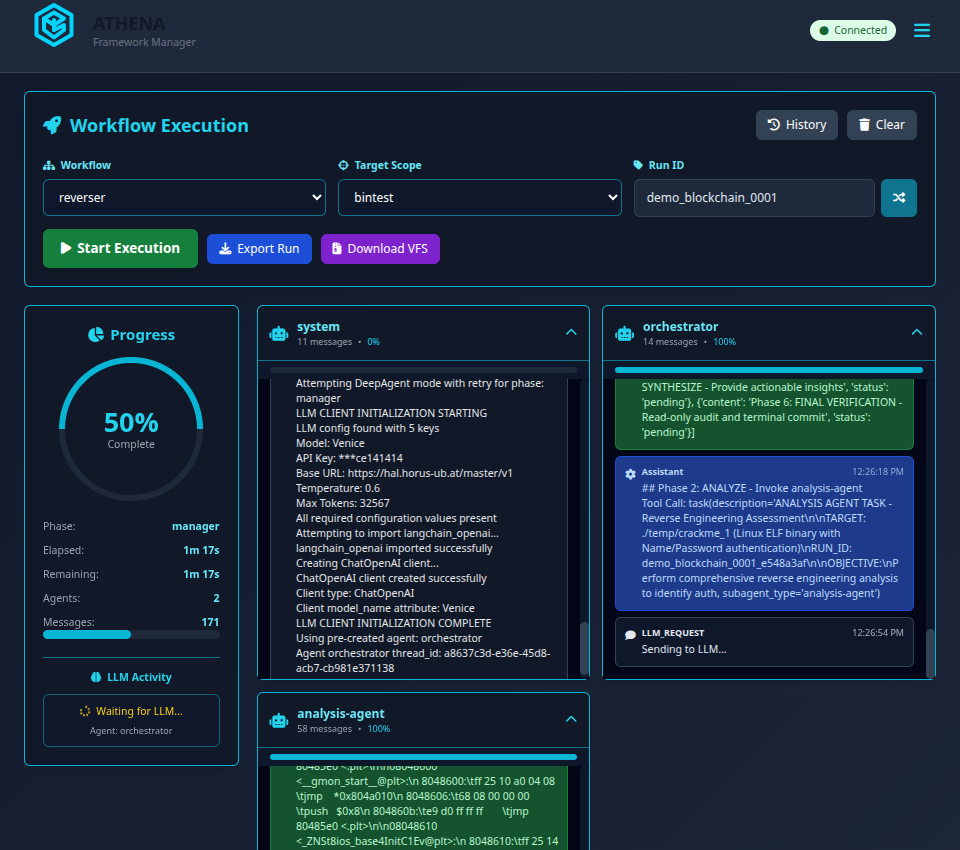
Implementation Approach
- Discovery — identify high-impact automation opportunities.
- Blueprinting — design the AI strategy, workflows, and the required agent architecture.
- Deployment & Scaling — build, integrate, deploy, and continuously optimize workflows and agents.
Differentiation
- Data sovereignty (ATHENA strongly supports usage of local LLM systems)
- Focus on full workflow automation rather than simple chatbots
- Combination of central intelligence and specialized agents
- Strong customization and integration potential
- Can be integrated into existing software solutions and CI/CD environments
Bottom line: ATHENA Agents enable businesses to become AI-driven organizations by deploying coordinated systems of autonomous agents that plan, execute, and optimize workflows.
Where ATHENA Agents Meet the EU AI Act
Sample Scenario Overview
An imaginary electricity grid operator in the EU deploys ATHENA to autonomously plan and execute continuous cybersecurity scanning across infrastructure used in electricity supply. Financial institutions can also fall into comparable critical-infrastructure contexts.
- Collect data on network topology, devices, and exposed services
- Decide what to scan, when, and how within defined parameters
- Identify vulnerabilities and misconfigurations
- Propose security improvements such as segmentation and access controls
- Feed recommendations into existing change-management processes
Because this system supports the safe operation of electricity infrastructure, ATHENA qualifies as a high-risk AI system under the EU AI Act.
Legal Classification under the EU AI Act
Under Article 6(2) and Annex III, AI systems are classified as high-risk if they are used as safety components in critical infrastructure.
This applies because:
- The system meets the definition of an AI system under Article 3
- It influences security and operational safety of electricity supply
- Electricity infrastructure is explicitly listed as critical infrastructure
AI systems used as safety components in the management and operation of critical infrastructure, including electricity supply.
Recital 55 explains the rationale: failures in such systems can endanger public safety and disrupt essential services.
Core Obligations for High-Risk AI Systems
Once classified as high-risk, the system must comply with key requirements in Articles 9 to 17.
- Use relevant, representative, and high-quality data
- Document data sources such as configurations, logs, and incidents
- Ensure coverage of normal and edge-case scenarios
- Maintain validation and versioning processes
- Document intended purpose, architecture, and components
- Describe models, logic, and decision processes
- Explain data characteristics and governance
- Show compliance and robustness measures
- Record key actions and decisions
- Log outputs and recommendations with context
- Enable auditability and investigation
- Provide clear instructions and known limitations
- Ensure effective human oversight mechanisms
- Allow review, validation, and override of critical outputs
The system must maintain a high level of reliability, withstand errors and attacks, and match its robustness to the critical role it plays in infrastructure.
Practical Implications
- Careful integration into operational processes
- Human review of critical outputs such as configuration changes
- Strong monitoring, logging, and validation mechanisms
- Protection against misuse and manipulation
Failure to comply can lead to significant legal and financial penalties.
Key References
- EU AI Act Overview
- Annex III — High-Risk Systems
- Recital 55 — Critical Infrastructure Rationale
- High-Risk Requirements Summary
How to Reliably Document and Store Data Produced by AI Systems
The Concept of Digital Data Certification and Notarization
Digital certification proves that data existed in a specific form at a specific time by anchoring its cryptographic fingerprint, or hash, on a blockchain.
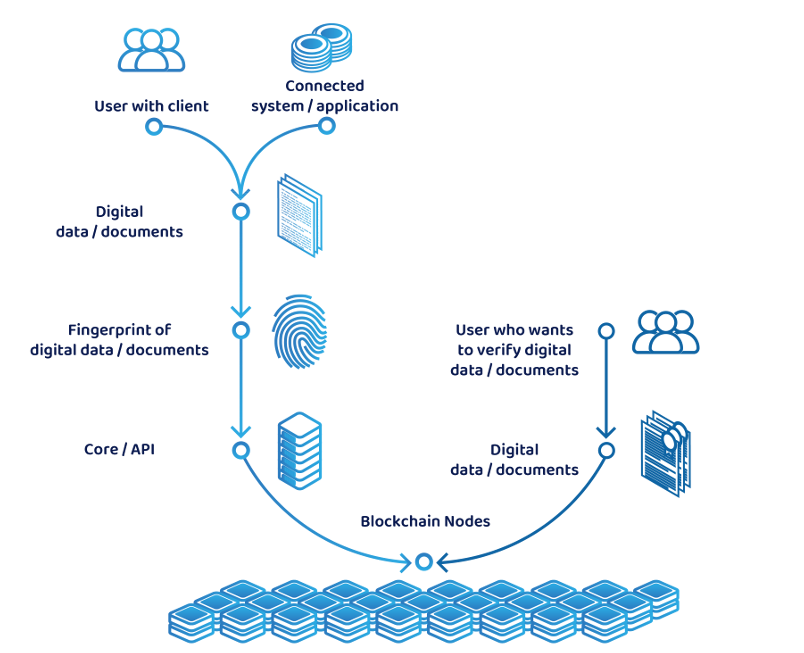
Why Blockchains Are Immutable
- Cryptographic chaining — each block contains the hash of the previous block, so changing one entry breaks the chain.
- Decentralization — data is replicated across many nodes, so no single party can alter records alone.
- Consensus mechanisms — changes require network agreement, making unauthorized edits impractical.
- Append-only structure — records are added, not silently modified or deleted.
Advantages over Classic Digital Signatures
- Ensures the data itself cannot be altered unnoticed
- Works without depending on a single central authority
- Provides long-term verifiability
- Allows independent verification
- Mainly verify authorship and integrity at signing time
- Depend on certificate authorities
- Can expire or become invalid
- Rely more heavily on third-party trust infrastructure
Bottom line: Digital certification using blockchain makes data effectively immutable because the fingerprint is stored on a tamper-resistant, decentralized ledger, any modification becomes mathematically detectable, and verification remains permanent, transparent, and independent.
ATHENA Uses Digital Notarization for Robust AI Documentation
ATHENA uses the API interfaces provided by infinite trust digital GmbH (https://infinite-trust-digital.com/) for blockchain notarization.
While running, ATHENA stores every request to a local or cloud LLM API together with the corresponding data in a so-called manifest.
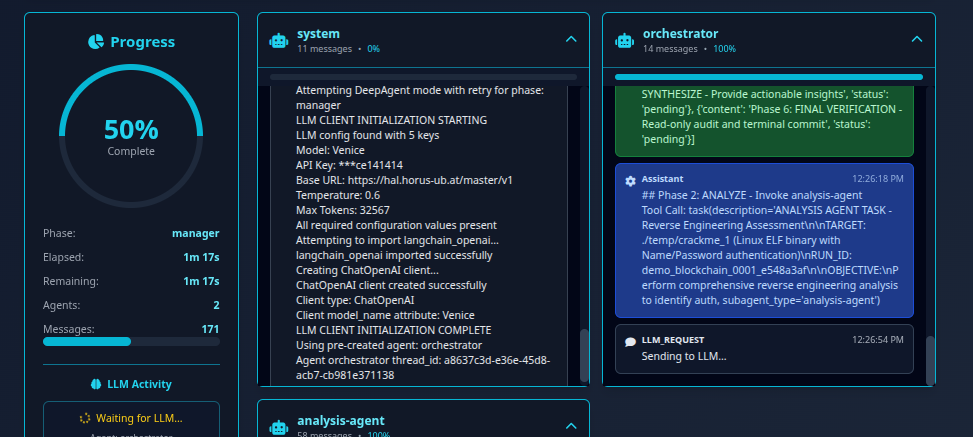
In the background, many thousands of data points and model requests are generated. In larger runs, this can easily exceed 100,000 records.
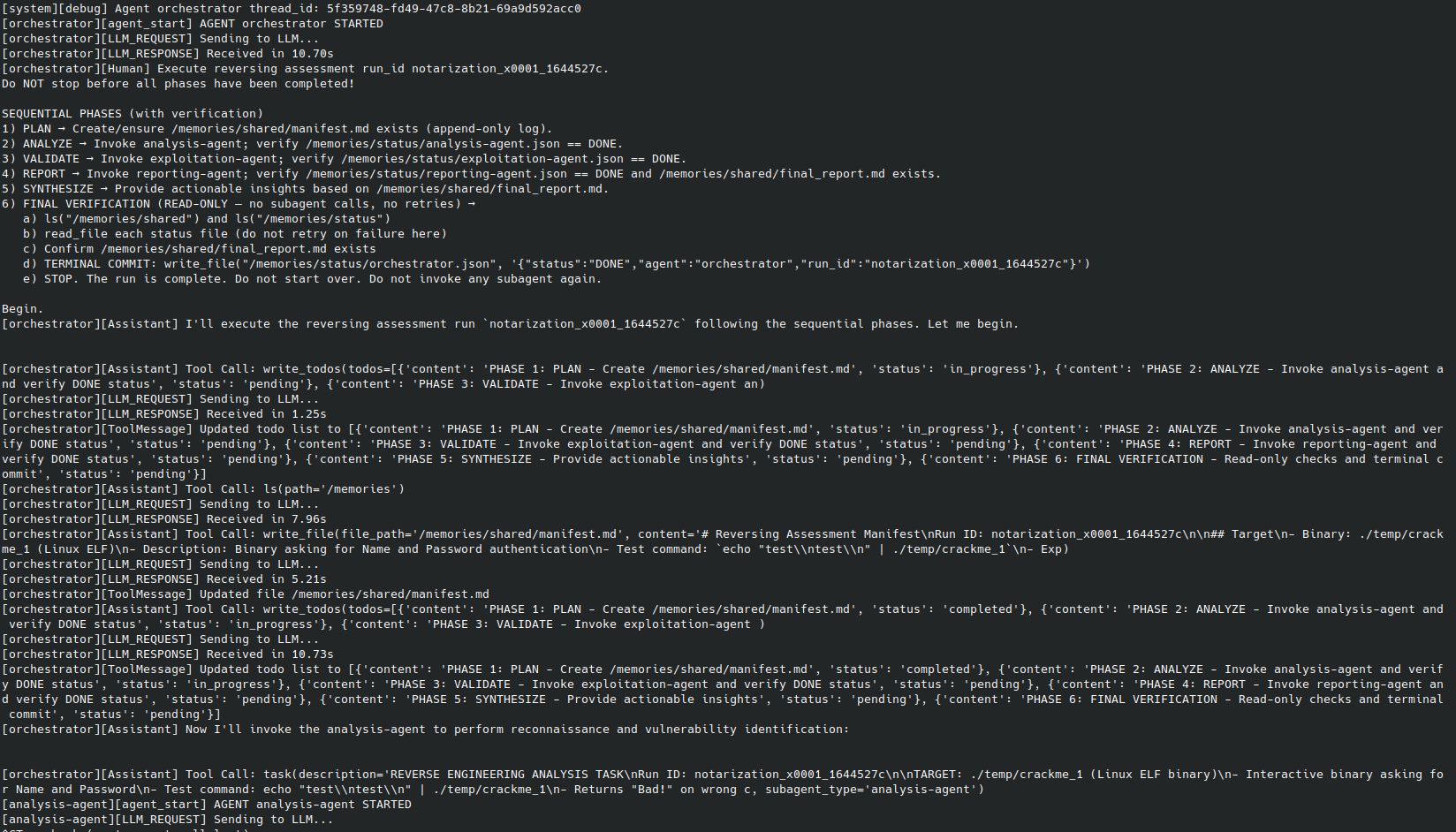
To keep data consistent and preserved, these runs are compressed into ZIP archives.
Those ZIP files are then notarized in the Austrian PSBC (Private Sector Blockchain) using an API provided by Infinite Trust Digital. After notarization, the data is stored in a secure location. The ZIP files and their contents are never transmitted over the internet or stored outside the customer’s ATHENA servers.

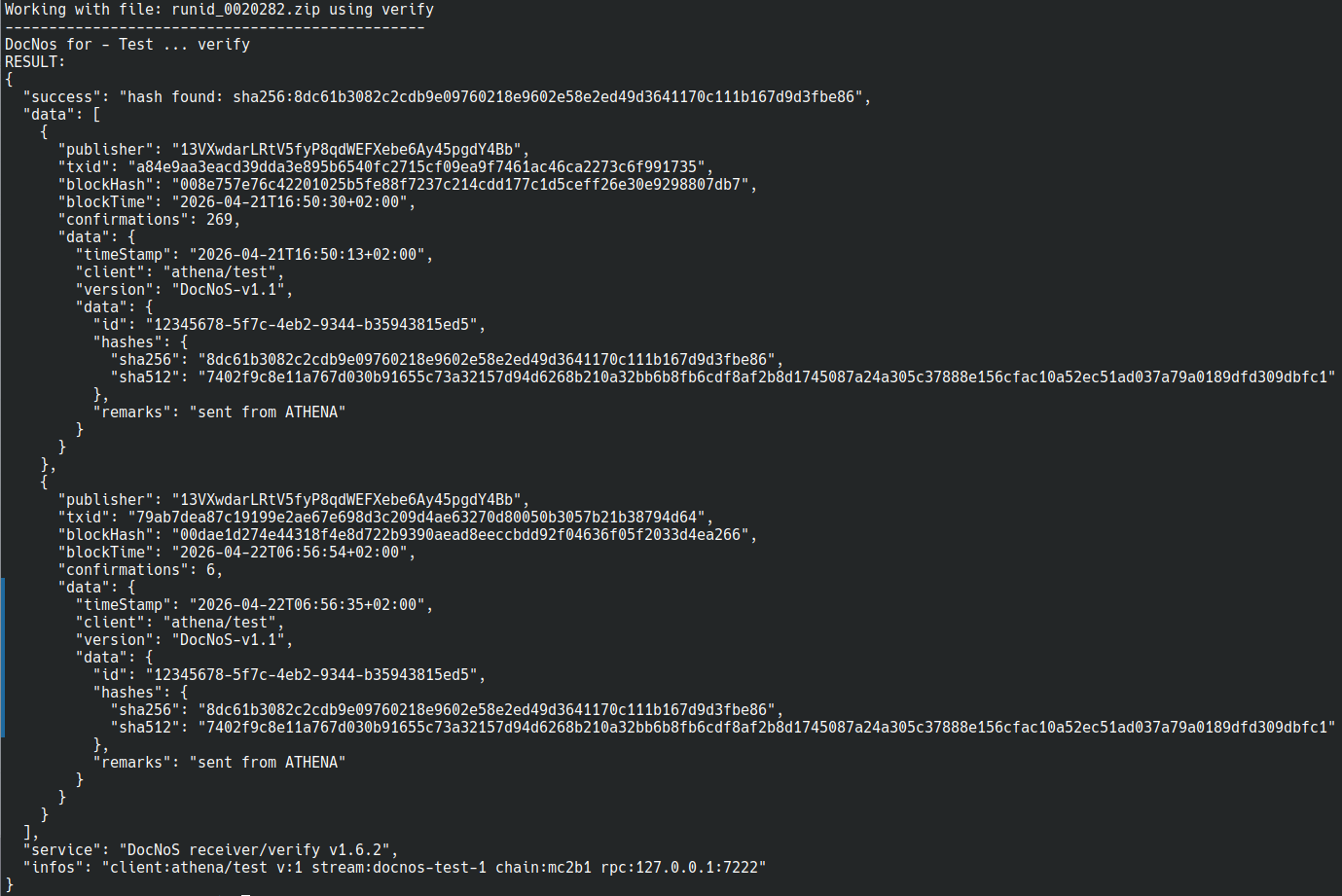
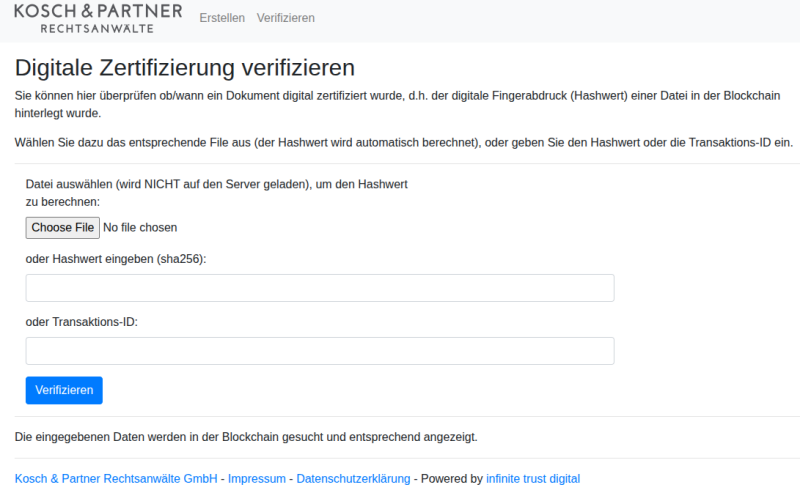
At any later point, the files and their hashes can be verified locally or by using free online verification services.
- proof.li — reference implementation
- datenzertifizierung.at — Austrian Chamber of Commerce
- node01.docnodes.de — German implementation
- digicert.kosch-partner.at — law firm implementation
Related Example
ATHENA is not the only cybersecurity firm using digital certification.
CyberDanube is an IT and OT infrastructure security consulting and testing company that uses the same blockchain for digital certification of critical user data.
More information on Cyberdanube s digital certifaction process: https://infinite-trust-digital.com/blog20230220.html
More background on the used Blockchain (Austrian private service Blockchain): https://www.bci-austria.com/
For more information on blockchain technology and how to implement blockchain applications in real-world scenarios, contact office@infinite-trust-digital.com.